 "The building is designed for residents who can still live on their own and look after themselves. It faces the Kronengasse and the old center of Masans. At the rear is the existing old people's home, whose nursing facilities can be used as required. Throughout the complex, consisting of 21 apartments, a guest room and a staff room, all connected by external corridors, one can see evidence of the declared design objectives, i.e. the creation of a rural atmosphere in a suburban setting, the sensuous presence of the materials (a basic triad of exposed concrete, tufa and larchwood), and clarity and legibility of construction detail. We want the building to seem relaxed and informal, like a big ‘rock’ in the open expanses of a mountain landscape, expertly worked with precise, careful, perhaps even old-fashioned craftsmanship.
The plan of the building is based on the idea of solid elements (supporting masonry piers, solid sanitary blocks, nonsupporting wooden boxes) placed at regular intervals in the overall ground plan within a large, flowing continuum of space.
The residents are welcome to furnish as they please their section of the large entrance porch to the east, which they overlook from their kitchen windows, and they make ample use of this opportunity. The sheltered balcony niches and the living room bow (bay) windows on the other side face west, up the valley, towards the setting sun". Peter Zumthor
https://vimeo.com/38136721
 Designed as housing for postmen, the building contains 26 apartments for rent, with business offices on the ground floor and a car park in the basement. The opening dividing the building sharply into two is a response to the unique geometry of the site, which is meant to be actively connected to its urban context. The disconnected street-facing mass contains seven storeys, while the building part realised in the depth of the site adjusts to its environment with its lower mass. Open terraces on each level act as transitions between public and private areas. The wide entrance, the spectacular escape stairs and the corridors leading to the apartments facilitate direct contact with the urban plaza. The systematic use of brick and wood lends elegance to the open terraces, which also function as meeting places when weather permits.
Núcleo central que concentra as infraestruturas e que organiza os ambientes por meio de painéis que correm.
fonte:
Projeto da moradia estudantil na UNICAMP, construção com a aplicação de painéis cerâmicos pré-fabricados do arquiteto Joan Villà, com utilização de tecnologia simples e acessível, e de sua importância como uma contribuição experimental e inovadora à arquitetura brasileira.
fonte:
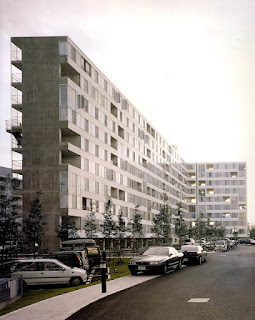
Located at the intersection of the industrial and residential zones of Kitagata, the area is defined by four 10-storey apartment buildings along its four sides. Built after masterplans by Arata Isozaki, they were designed by four women architects. The public plaza framed by the development contains parking spaces and thematic communal areas designed by Martha Schwartz. The essential proposal of the housing concept by Kazuyo Sejima is that the basic module of an owner-occupied, multi-apartment house is not the apartment, but the room. Thus, Kitagata Housing contains co-ordinated sequences of 2.6 x 4.8 m rooms based on four typologies – namely, the bedroom, the living room, the tatami room and an open area (terrace). The bedroom, en-suite shower and toilet are the most intimate parts in each unit. The living rooms feature a dining area and a kitchen, and some of them have double interior height. The terrace takes up the entire width of the building and is in direct contact with the shared circulation that wraps around the building along its perimeter. The apartments feature a variety of designs, containing 4-7 rooms. The glazed, portico-like outer circulation makes the building transparent, whereby tenants living in anonymity have the chance to socialise. The door to each room-unit opens onto the shared circulation system, which is a solution overwriting the structuring of traditional apartment houses.


fonte:
Link para download de bases do EE Caetano de Campos, que inclui o edifício do Teatro do L4 na rua Gravataí:
https://www.dropbox.com/sh/39gfo4x8rwzh7he/AABHOHdJIJDEQTt3aPWuENYea?dl=0
 O material foi cedido pelo Apiacás Arquiteto, que desenvolveu projeto para o conjunto da escola em 2009.
 link com matéria da revista acrópole com plantas do edifício sede do Instituto de Arquitetos do Brasil - São Paulo:
http://www.acropole.fau.usp.br/edicao/121/3
 Link para acesso ao programa da disciplina AUP-158 e suas bases principais:
http://www.fau.usp.br/cursos/graduacao/arq_urbanismo/disciplinas/aup0158/index.html
Link para acesso ao programa da disciplina AUP-162 e suas bases principais:
http://www.fau.usp.br/cursos/graduacao/arq_urbanismo/disciplinas/aup0162/index.html
 "The building is designed for residents who can still live on their own and look after themselves. It faces the Kronengasse and the old center of Masans. At the rear is the existing old people's home, whose nursing facilities can be used as required. Throughout the complex, consisting of 21 apartments, a guest room and a staff room, all connected by external corridors, one can see evidence of the declared design objectives, i.e. the creation of a rural atmosphere in a suburban setting, the sensuous presence of the materials (a basic triad of exposed concrete, tufa and larchwood), and clarity and legibility of construction detail. We want the building to seem relaxed and informal, like a big ‘rock’ in the open expanses of a mountain landscape, expertly worked with precise, careful, perhaps even old-fashioned craftsmanship.


Follow Us